Laser Cutting Process: Technology, Applications, and Advantages
Laser cutting has revolutionized modern manufacturing, transforming how industries shape and fabricate materials. By utilizing a high-powered, focused beam of light, this advanced thermal cutting technology delivers exceptional precision, speed, and versatility. Whether used in high-volume automotive production or intricate aerospace components, laser cutting has become an indispensable process in contemporary engineering. This article provides an in-depth exploration of the laser cutting process, examining its underlying mechanics, system types, operational steps, key advantages, and industrial applications.
- Introduction and Core Mechanism
At its core, laser cutting is a thermal separation process. The acronym LASER stands for Light Amplification by Stimulated Emission of Radiation. The process works by directing a high-density, monochromatic, and coherent beam of light onto the surface of a workpiece.
When the laser beam strikes the material, the intense energy is rapidly absorbed, causing the targeted area to heat up instantly. Depending on the material and application, this energy causes the material to melt, burn, vaporize completely, or be blown away by a high-pressure assist gas jet. A computer numerical control (CNC) system guides the laser beam along a predetermined geometric path, enabling the creation of complex shapes with tight tolerances. - Main Types of Laser Cutting Systems
Different industrial applications require different laser sources. There are three primary types of laser cutting systems widely used today:
CO2 Lasers: Utilizing a gas mixture primarily composed of carbon dioxide, CO2 lasers operate in the infrared spectrum (typically around 10.6 micrometers wavelength). They are highly effective for cutting, drilling, and engraving non-metallic materials (such as wood, acrylic, glass, and textiles) as well as thick metallic sheets due to their smooth edge finish.
Fiber Lasers: Representing the modern standard for metal cutting, fiber lasers use seed lasers amplified by specialized glass fibers doped with rare-earth elements (like ytterbium). Operating at a shorter wavelength (around 1.06 micrometers), fiber lasers offer significantly higher energy absorption in metals, faster cutting speeds, and lower maintenance costs compared to CO2 systems.
Crystal Lasers: Built using solid-state crystal media (such as Nd:YAG or Nd:YVO), these lasers produce high-intensity beams capable of cutting both metals and non-metals. Although largely superseded by fiber lasers in high-speed sheet metal processing, they remain valuable in specific specialized marking and micro-machining applications. - Step-by-Step Laser Cutting Workflow
Executing a successful laser cutting job involves several structured phases, moving from digital design to final product delivery:
Step 1: CAD/CAM Preparation
The process begins with the creation of a digital 2D or 3D computer-aided design (CAD) model of the part. This file is then imported into computer-aided manufacturing (CAM) software, where technicians nest parts to optimize material utilization, minimize waste, and define cutting paths, lead-in lines, and piercing points.
Step 2: Machine Setup and Material Loading
The raw material (such as stainless steel, aluminum, carbon sheet, or brass) is loaded onto the laser cutting bed. The operator configures the machine parameters—including laser power, cutting speed, focal position, and nozzle standoff distance—based on the material type and thickness.
Step 3: Assist Gas Selection
Assist gases play a critical role in the cutting zone. Common gases include:
Oxygen (O_2): Exothermic reaction aids in cutting carbon steel by accelerating the melting process.
Nitrogen (N_2): An inert gas used to blow away molten metal without oxidation, resulting in clean, bright edges on stainless steel and aluminum.
Compressed Air: A cost-effective alternative for cutting thinner metals where high aesthetic finish is secondary.
Step 4: Execution and Piercing
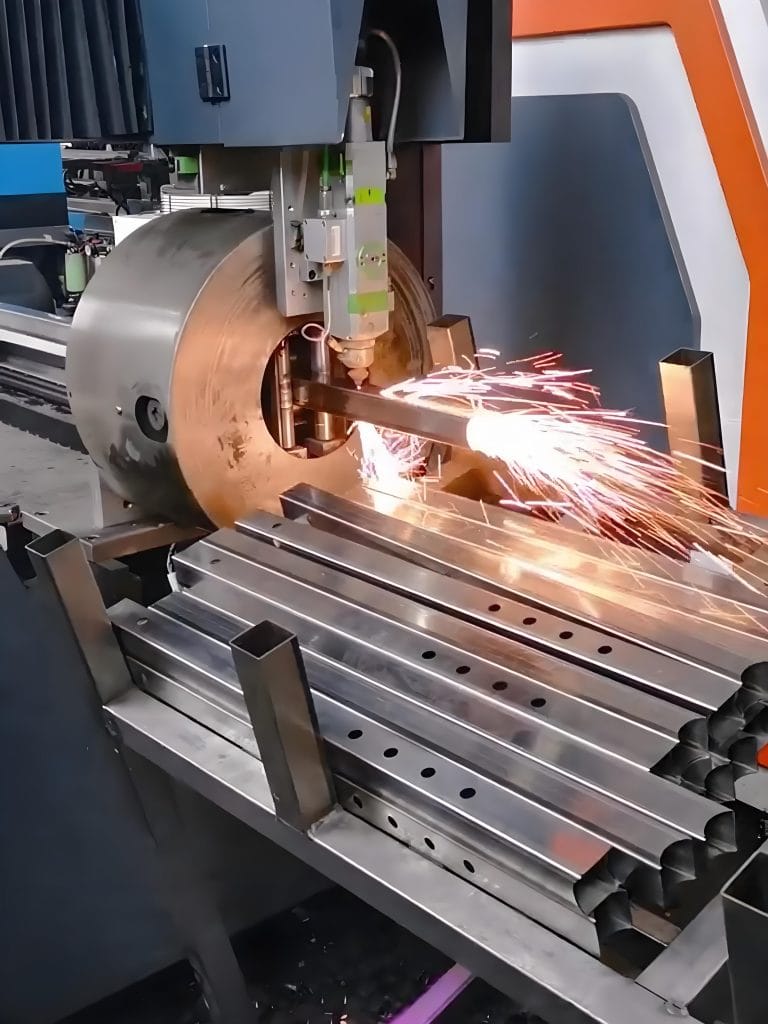
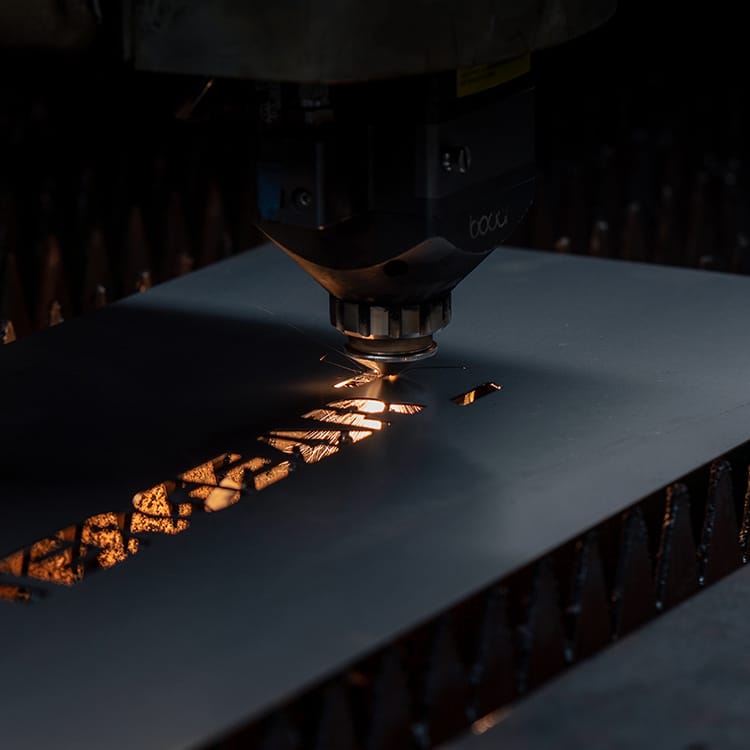
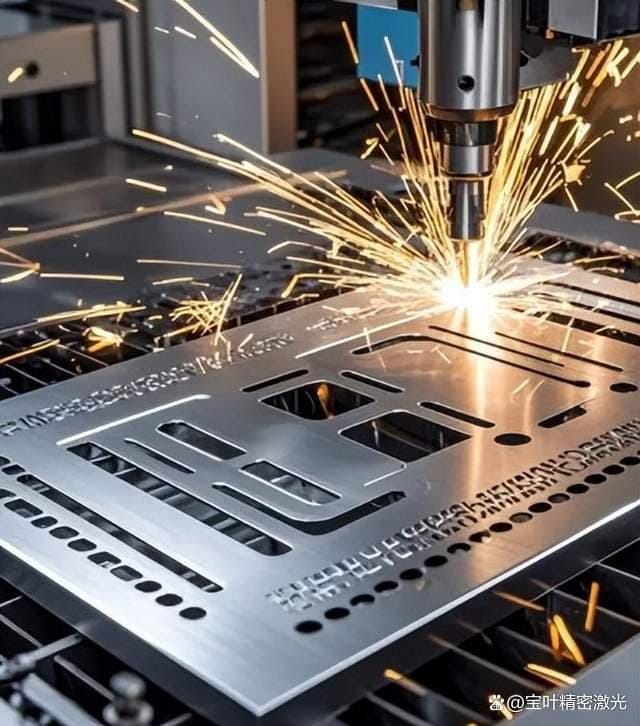
The laser initiates a pierce point to penetrate the material, followed by continuous contour cutting along the programmed CNC path. The dynamic interaction between thermal energy and the high-pressure gas jet cleanly separates the cut piece from the skeleton scrap.
Step 5: Post-Processing and Quality Inspection
While laser cutting produces exceptionally clean cuts, finished parts may require minor post-processing such as deburring, cleaning, or surface finishing. Quality inspection ensures dimensional accuracy against the original CAD blueprints. - Key Advantages of Laser Cutting
Laser cutting has largely replaced traditional mechanical cutting methods (like stamping, shearing, or plasma cutting) due to several distinct benefits:
Extreme Precision and Accuracy: Laser systems achieve tight tolerances (often within fractions of a millimeter), enabling the fabrication of intricate patterns and micro-features.
Narrow Kerf Width: The focused beam creates a very thin cutting kerf, minimizing material loss and allowing for tight nesting of parts.
Minimal Heat-Affected Zone (HAZ): Because the thermal energy is localized, the surrounding material experiences minimal thermal distortion or warping.
Automation and Flexibility: CNC integration allows for rapid switching between different designs without the need for expensive physical hard tooling. - Industrial Applications
The versatility of laser cutting makes it vital across numerous sectors:
Automotive Industry: Manufacturing custom chassis components, exhaust systems, interior brackets, and body panels.
Aerospace Engineering: Cutting high-strength, heat-resistant superalloys for turbine engines and structural airframe components.
Electronics and Electrical: Fabricating delicate enclosures, circuit board components, and control panels.
Medical Technology: Producing precise surgical instruments, stents, and diagnostic equipment housing. - Conclusion
The laser cutting process represents a powerful fusion of optics, electronics, and mechanical engineering. By combining high precision, adaptability, and efficiency, it continues to drive innovation in manufacturing worldwide. As laser technology advances with higher power outputs and smarter AI-driven monitoring systems, its capabilities will only expand further, cementing its role as a cornerstone of modern industrial production.
What specific material or application are you planning to use laser cutting for?